Learn Hiragana: The Ultimate Guide for Beginners [2026]
Starting to learn the Japanese language is an amazing achievement. Whether you aim to pass the JLPT N5 exam or prepare for the JFT-Basic test for employment visas, start by understanding the writing system.
The Japanese writing system consists of three different scripts: Hiragana, Katakana, and Kanji. Complete beginners should begin with learning Hiragana. It’s the phonetic basis for saying words, understanding grammar, and reading Japanese literature before you go deeper into the intricate details of kanji.
Title:
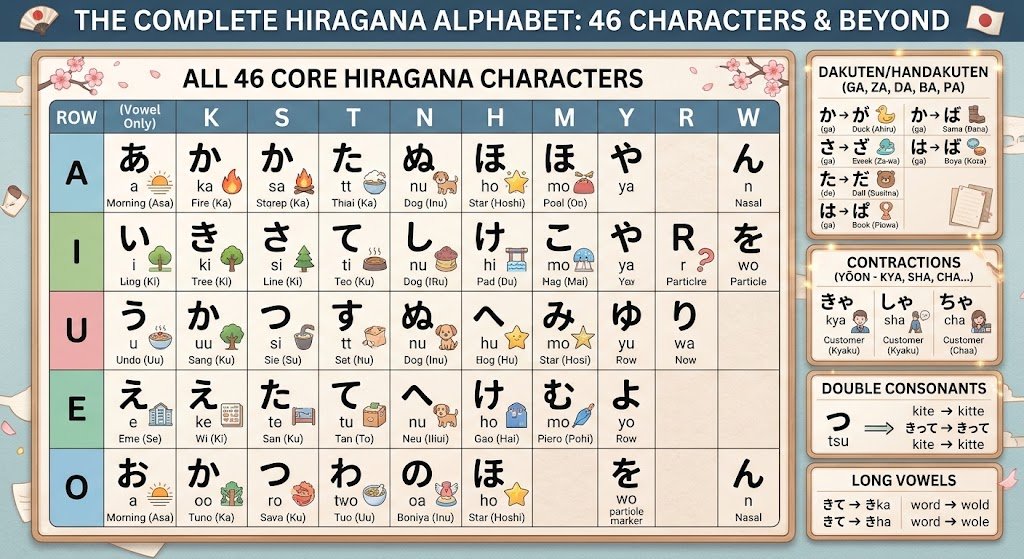
This massive guide is going to break down all 46 basic Hiragana letters, explain how they are pronounced, provide you with some effective visual memory aids, and give you a thorough study plan to memorize them in days instead of weeks.
Why Start with Hiragana?
Hiragana (ひらがな) is a curvy, flowing phonetic script used for native Japanese words, grammatical particles, and verb inflections. Because every sound in Japanese can be written in Hiragana, it is always taught first to children and international learners.
Unlike English, which features complex spelling irregularities, Hiragana is 100% phonetic—every character is pronounced the same way every time you see it.
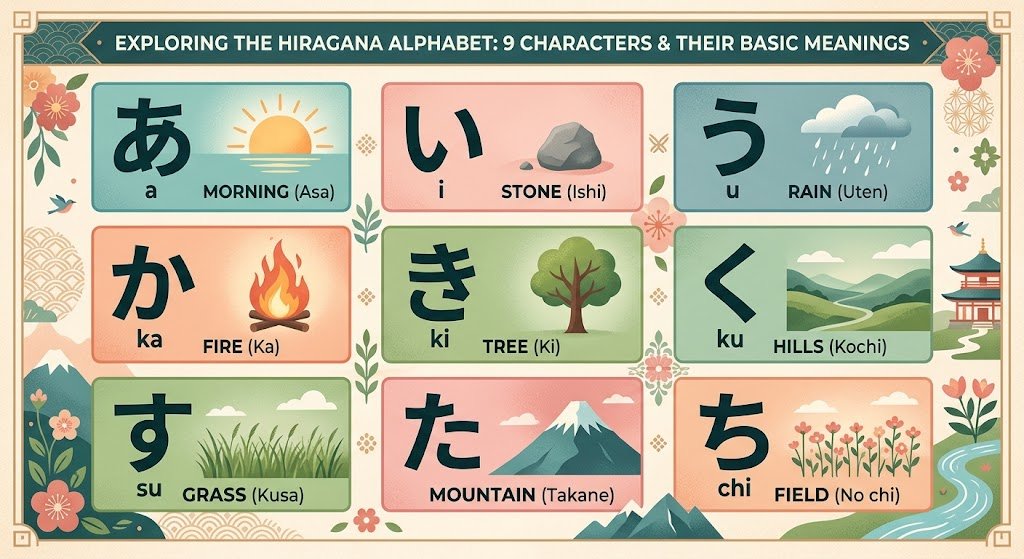
Step 1: The Five Basic Vowels (あいうえお)
Every consonant in Japanese builds upon the five core vowel sounds. Mastering these five characters is your first priority:
- あ (a): Sounds like the “a” in father.
- い (i): Sounds like the “ee” in see.
- う (u): Sounds like the “oo” in boot (without rounding your lips as much).
- え (e): Sounds like the “e” in pet.
- お (o): Sounds like the “o” in poke.
Step 2: The Consonant Columns
Once you know your vowels, you simply add consonants in columns:
- K-Column: か (ka), き (ki), く (ku), け (ke), こ (ko)
- S-Column: さ (sa), し (shi), す (su), せ (se), そ (so) — Note that ‘shi’ is unique!
- T-Column: た (ta), ち (chi), つ (tsu), て (te), と (to) — Note ‘chi’ and ‘tsu’!
- N-Column: な (na), に (ni), ぬ (nu), ね (ne), の (no)
- H-Column: は (ha), ひ (hi), ふ (fu), へ (he), ほ (ho)—Note: ‘fu’ sounds close to ‘who’!
- M-Column: ま (ma), み (mi), む (mu), め (me), も (mo)
- Y-Column: や (ya), ゆ (yu), よ (yo)—Only three characters in modern Japanese.
- R-Column: ら (ra), り (ri), る (ru), れ (re), ろ (ro)—Pronounced with a soft flap like a quick ‘d’ or ‘r’.
- W-Column & N: わ (wa), を (wo—used mostly as a particle), ん (n—the only standalone consonant).
Proven Memory Hacks to Learn Hiragana Fast
- Use Visual Mnemonics: Associate each character’s shape with an English keyword. For example, Hiragana つ (tsu) looks like a sideways tsunami wave.
- Master One Column at a Day: Don’t try to cram all 46 characters at once. Take 5 to 7 days, focusing on 1 or 2 columns daily.
- Practice Handwriting: Muscle memory is critical. Write out each character repeatedly on grid paper.
- Test Yourself Daily: Use flashcards or interactive quizzes to keep your recall speed sharp.
Frequently Asked Questions About Learning Hiragana
Hiragana is the fundamental phonetic writing system in Japanese used for native words, grammar particles, and verb inflections. You should learn it first because it forms the building blocks of Japanese reading and writing before tackling Katakana and Kanji.
There are 46 basic characters in the Hiragana syllabary, starting with the 5 core vowels (あ、い、う、え、お) and expanding through various consonant columns like K, S, T, N, H, M, Y, R, W, and the standalone nasal sound ‘ん’.
Most dedicated beginners can memorize all 46 Hiragana characters within 5 to 7 days by focusing on one or two columns a day and practicing daily via active recall and handwriting drills.
Yes! Unlike English, which has many spelling irregularities, Hiragana is completely phonetic. Every character is pronounced the exact same way every time you see it.
The most effective strategy is using visual mnemonics—associating each character’s shape with an English keyword or object (for example, seeing the letter つ as a sideways tsunami wave)—combined with spaced repetition flashcards.
Absolutely. Practicing handwriting on grid paper builds vital muscle memory, teaches you correct stroke order, and helps your brain distinguish between visually similar characters like <code>さ (sa)</code> and <code>ち (chi)</code>.
While both represent the exact same 46 core phonetic sounds, Hiragana is used for native Japanese words and grammar particles, whereas Katakana is primarily used for foreign loanwords, foreign names, and onomatopoeia.
You should transition to Katakana only after you can read, write, and recall all 46 Hiragana characters smoothly without hesitation (usually after about a week of solid practice).
Beginners frequently mix up characters with similar shapes or strokes, such as <code>き (ki)</code> and <code>さ (sa)</code>, or <code>ね (ne)</code>, <code>れ (re)</code>, and <code>わ (wa)</code>. Pay close attention to their loop structures!
Small versions of ‘ya’, ‘yu’, and ‘yo’ are combined with consonant-i ending characters (like き in <code>きょ / kyo</code>) to create contracted compound sounds (yōon), reducing two syllables into a single blended syllable.
The small tsu represents a “glottal stop” or a double consonant sound (sokuon) in Japanese, creating a brief pause or silence before the next consonant sound (for example, turning <code>きて (kite)</code> into <code>きって (kitte)</code>).
Certain Hiragana characters change their pronunciation or function when used as grammar particles. For instance, the character <code>は</code> is pronounced ‘wa’ when acting as a topic marker, and <code>を</code> is pronounced ‘o’ to mark direct objects.
No, learning Kanji before Hiragana is nearly impossible because Kanji readings (both on’yomi and kun’yomi) are typically written out or annotated using Hiragana (known as *furigana*).
Yes. Absolute fluency in Hiragana is a mandatory prerequisite for passing the JLPT N5 exam and the JFT-Basic employment visa test, as questions and basic readings rely heavily on it.
Spaced repetition system (SRS) apps like Anki, digital flashcard sets, and interactive stroke-order tracing tools are fantastic digital supplements to accelerate your daily character retention.
Conclusion
When you learn Hiragana, you unlock the gateway to reading and writing Japanese fluently. Take it one column at a time, practice daily, and you will have all 46 characters memorized before you know it.
Once you are comfortable with Hiragana, your next step is exploring Katakana and basic vocabulary builders!