
Complete Guide to the JFT-Basic Test: Format & Passing Score
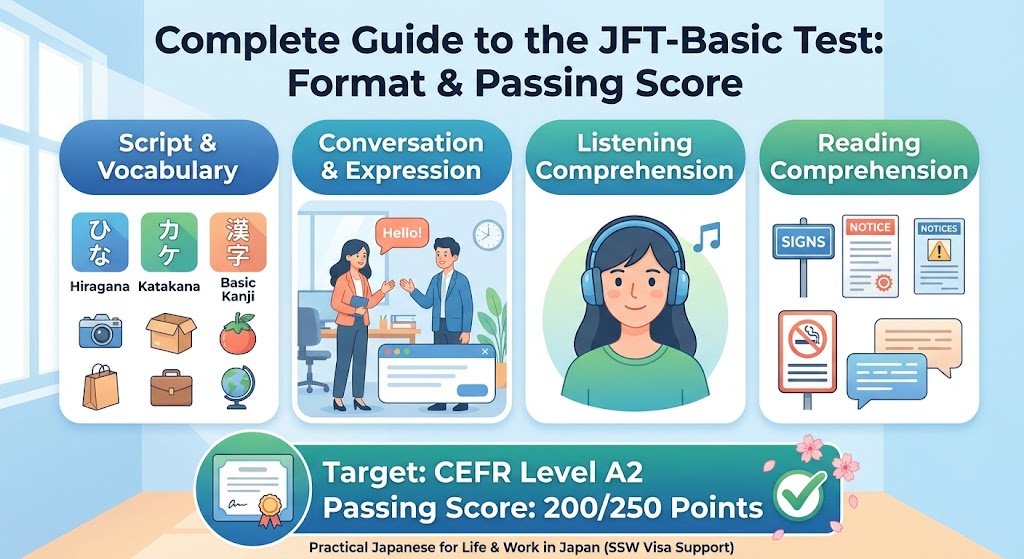
Welcome to the complete guide to the JFT-Basic test: format, passing score, and study strategies you need to relocate to Japan through the Specified Skilled Worker (SSW) visa program. Are you considering relocating to Japan through the Specified Skilled Worker (SSW) visa initiative? A significant landmark in your progression is successfully completing the JFT-Basic (Japan Foundation Test for Basic Japanese Communication). In contrast to academic language assessments, the JFT-Basic is tailored to evaluate your practical, day-to-day Japanese communication skills, which are necessary for comfortable living and working in Japan. In this comprehensive manual, we will elucidate the precise test structure, evaluation methodology, passing standards, and effective study strategies to assist you in achieving success on your initial try.
What is the JFT-Basic Test?
The JFT-Basic is a computer-based test (CBT) administered by the Japan Foundation. It evaluates your ability to handle real-life scenarios in Japan, such as shopping, navigating public transport, understanding workplace instructions, and chatting with colleagues.
Key Facts at a Glance:
- Format: Computer-Based Test (CBT) at approved Prometric centers.
- Duration: Approximately 60 minutes (no breaks between sections).
- Total Questions: Approximately 50 questions across 4 sections.
- Score Range: 10 to 250 points.
- Passing Score: 200 points (corresponds to CEFR Level A2).
- Frequency: Multiple times a year, depending on the testing center location.
JFT-Basic Test Format & Section Breakdown
The exam is conducted entirely on a computer. You will read text prompts on the screen and listen to audio recordings through headphones. The test is divided into four distinct sections:
| Section | What It Tests | Approximate Questions |
|---|---|---|
| 1. Script and Vocabulary (Moji to Goi) | Reading hiragana, katakana, and basic kanji and understanding everyday words. | Around 12 |
| 2. Conversation and Expression (Kaiwa to Hyougen) | Choosing natural phrases, grammar, and responses for common daily situations. | Around 12 |
| 3. Listening Comprehension (Choukai) | Understanding short conversations, announcements, and instructions at natural speed. | Around 12 |
| 4. Reading Comprehension (Dokkai) | Understanding short signs, notices, schedules, messages, and work memos. | Around 12 |
Note: There are no separate time limits for individual sections, but once you move forward, you cannot go back to previous questions. Manage your time wisely!
JFT-Basic Scoring System & Passing Criteria
Understanding how the test is scored prevents nasty surprises on exam day.
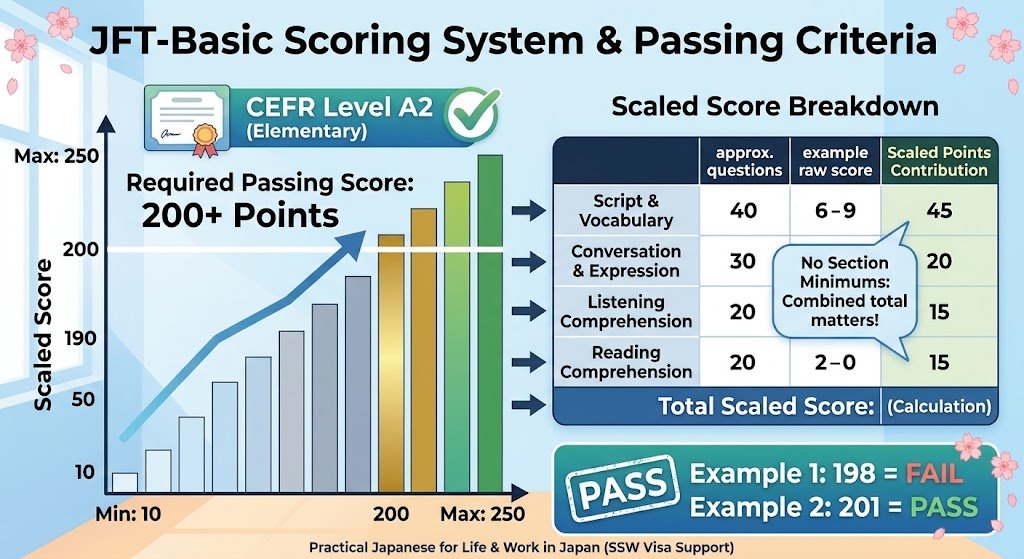
- The Scoring Scale: Results are measured on a scaled score from 10 to 250 points.
- The Passing Mark: You need a minimum score of 200 points to pass.
- The CEFR A2 Standard: A score of 200+ proves you have reached the A2 level (Elementary), meaning you can understand short, simple sentences and handle routine tasks.
- No Section Minimums: There are no separate pass marks for individual sections; your total combined score across all four sections determines whether you pass. However, performing extremely poorly in one section can heavily drag down your total.
Important Warning on Results: Please ensure you hit the full A2 (200+ points) benchmark. Partial scores or lower sub-levels do not satisfy the legal language proficiency requirement for the SSW visa.
Next Nation
JFT-Basic vs. JLPT N4: Which One Should You Take?
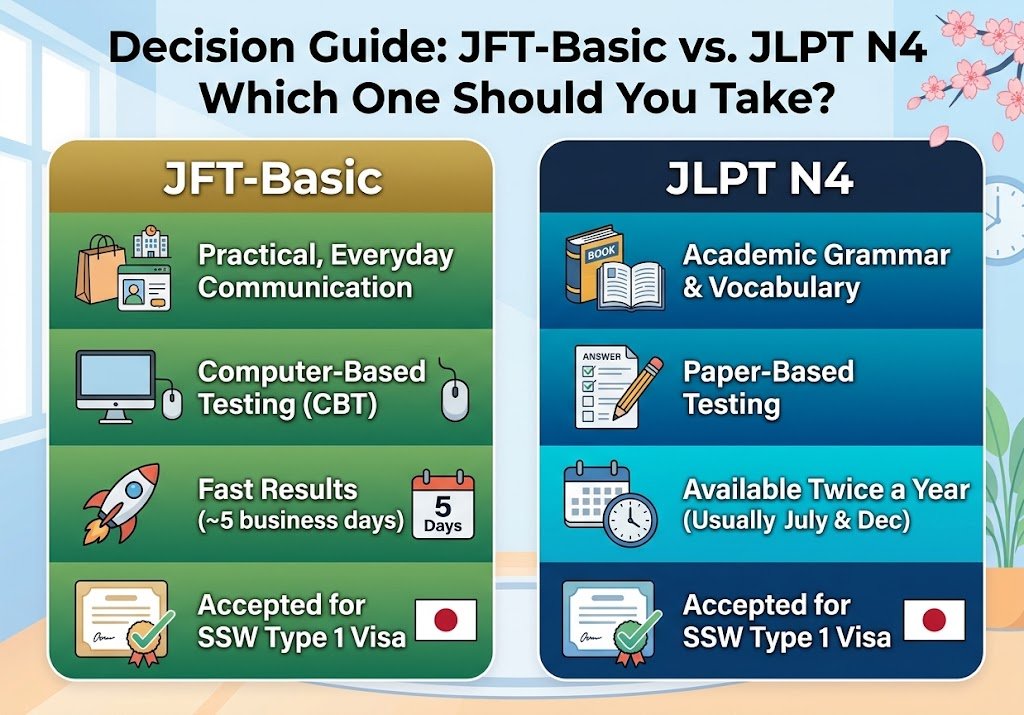
If you are preparing for the SSW visa, you generally have two choices for proving your language proficiency: JFT-Basic or JLPT N4 (or higher).
| Feature | JFT-Basic | JLPT N4 |
|---|---|---|
| Primary Focus | Practical, everyday “can-do” communication | Traditional grammar, vocabulary, and reading |
| Test Availability | Frequently available online throughout the year | Usually held only twice a year |
| Result Speed | Fast (available within 5 business days on My Page) | Slower (takes several weeks) |
| Visa Acceptance | Fully accepted for SSW visa | Fully accepted for SSW visa |
If you need quick certification to match an active job opening or employer interview, JFT-Basic is usually the preferred choice due to its frequent scheduling.
Proven Study Tips to Pass JFT-Basic
Passing the JFT-Basic requires more than just memorizing textbook grammar; it requires practical familiarity with real-world Japanese environments.
- Master Kana and Essential Kanji: Ensure you are completely comfortable reading Hiragana and Katakana. Learn basic kanji commonly found on public signs, transport maps, product labels, and workplace notices.
- Study Vocabulary by Situation: Group your vocabulary study into practical categories: shopping, medical visits, transportation, housing, and workplace instructions.
- Train Your Ear Daily: Listen to short dialogues, train station announcements, and natural-speed conversational clips. Focus on catching core details: Who? What? When? Where?
- Practice on a Computer: Because JFT-Basic is a computer-based test, simulate the experience beforehand. Use the official Japan Foundation sample tests to get comfortable reading off a screen and clicking through answers under time constraints.
Frequently Asked Questions (FAQs) about the JFT-Basic Test
You need a minimum score of 200 points out of 250 to pass the JFT-Basic test, which certifies you at CEFR Level A2.
No, there are no individual section minimums. Only your total combined score across all four sections matters for passing.
The test lasts approximately 60 minutes and consists of roughly 50 multiple-choice questions delivered via Computer-Based Testing (CBT).
Yes, passing the JFT-Basic test is fully recognized and accepted by the Japanese government to satisfy the language requirement for the SSW Type 1 visa.
JFT-Basic focuses on practical, everyday “can-do” communication and is available year-round with fast results, whereas JLPT N4 emphasizes traditional grammar and is usually only held twice a year.
The standard test fee is 7,000 JPY (or its equivalent local currency/USD depending on your testing region).
Your provisional score is shown on the computer screen immediately after finishing, and official score notifications are issued on your Prometric account within 5 business days.
Yes, you can retake the test, but there is a mandatory 45-day waiting period before you can book another attempt.
The score itself does not technically expire, but data is typically stored and accessible on your Prometric My Page portal for up to 5 years.
You can create an account and book your test slot online through the official Prometric registration website at least 3 business days prior to your desired exam date.
No, JFT-Basic is entirely multiple-choice (computer-based). There are no spoken output or handwritten writing tasks.
The official Japan Foundation textbook “Irodori: Japanese for Life in Japan” alongside the sample questions provided on the official JFT-Basic website are the best prep tools.
Final Thoughts & Next Steps
Passing the JFT-Basic test is your key gateway to working in Japan under the SSW program. Once you pass, you will combine your score certificate with your relevant skill evaluation test results for your industry (such as nursing care, Food Service, agriculture, or construction) to finalize your visa application.
Stay consistent with your daily practice, register early before test slots fill up, and take the first big step toward your career in Japan!

2 Comments