Katakana Complete Guide: From Zero to Proficiency
So, you’ve conquered Hiragana—congratulations! 🎉
Now it’s time to take on Katakana (カタカナ)—Japan’s second writing system and the one you’ll see everywhere from anime credits to restaurant menus.
Katakana is cool, sharp, and modern—it’s how the Japanese write foreign words, names, and sounds.
In this guide, you’ll learn everything: what Katakana is, how to master it quickly, and how to use it like a native.
🧭 What Is Katakana?
Katakana is one of the three scripts in the Japanese writing system (alongside Hiragana and Kanji).
While hiragana is used for native Japanese words, katakana is used mainly for:
-
Foreign loanwords (e.g., コンピューター = computer)
-
Foreign names (ジョン = John)
-
Onomatopoeia (ワンワン = woof-woof)
-
Emphasis (like italics in English)
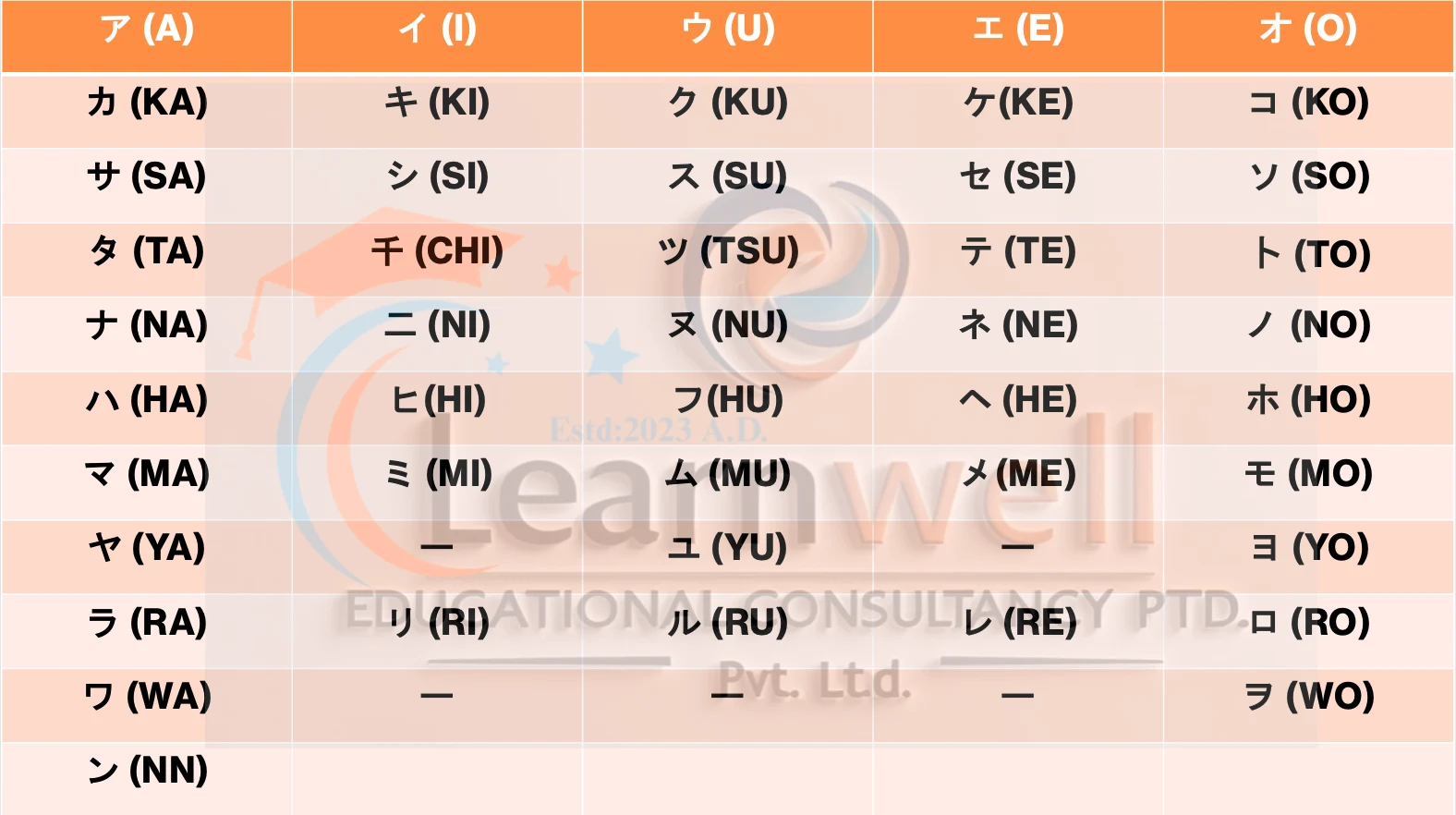
Katakana contains 46 basic characters, just like Hiragana—only the shapes differ.
If you want to learn physically or online, you should check this link.
| Vowels | A (ア) | I (イ) | U (ウ) | E (エ) | O (オ) |
|---|---|---|---|---|---|
| K | カ | キ | ク | ケ | コ |
| S | サ | シ | ス | セ | ソ |
| T | タ | チ | ツ | テ | ト |
| N | ナ | ニ | ヌ | ネ | ノ |
| H | ハ | ヒ | フ | ヘ | ホ |
| M | マ | ミ | ム | メ | モ |
| Y | ヤ | – | ユ | – | ヨ |
| R | ラ | リ | ル | レ | ロ |
| W | ワ | – | – | – | ヲ |
| N | ン | – | – | – | – |
✏️ Step 1: Learn Katakana Stroke Order
Katakana looks sharper and more angular than Hiragana—that’s intentional!
🖋️ Writing Tips:
-
Follow the stroke order—always top-to-bottom, left-to-right.
-
Write on squared paper (Genkouyoushi) – helps balance character proportions.
-
Practice with rhythm – write each character slowly and clearly.
👉 Use free worksheets from:
🧠 Step 2: Understand Katakana Sounds
Each Katakana symbol represents the same syllables as Hiragana, but many are used for foreign-sounding words.
Examples:
-
テーブル (teeburu) → table
-
コーヒー (koohii) → coffee
-
アイスクリーム (aisu kuriimu) → ice cream
Notice the long vowel marks (ー) used to stretch sounds — that’s unique to Katakana!
💡 Step 3: Use Mnemonics to Learn Faster
Mnemonics help connect symbols with mental images.
Examples:
-
シ (shi) looks like a smiling face saying “she!”
-
ソ (so) looks like a sewing needle and thread.
-
フ (fu) looks like a mountain — think “Fuji-san!”
-
メ (me) looks like an eye — “me” in Japanese means eye (目).
Use Tofugu’s Katakana Mnemonics Chart or the app Kana Mind for visual learning.
🏋️ Step 4: Practice Recognition with Common Loanwords
Most Katakana words are borrowed from English — so reading them is easier than you think!
| Katakana | English | Pronunciation |
|---|---|---|
| コーヒー | Coffee | kōhī |
| テレビ | Television | terebi |
| パン | Bread (from Portuguese “pão”) | pan |
| アニメ | Anime | anime |
| タクシー | Taxi | takushii |
| スマホ | Smartphone | sumaho |
💬 Tip: Read out loud! It helps you link sound and shape faster.
📱 Step 5: Use the Best Katakana Learning Apps
Here are the top-rated apps for learning Katakana effectively:
| App | Best Feature | Platform |
|---|---|---|
| LingoDeer | Structured Japanese courses | iOS / Android |
| Anki | Spaced repetition flashcards | Desktop / Mobile |
| Kana Town | Katakana writing & quiz modes | Android / iOS |
| Duolingo Japanese | Daily gamified lessons | Web / Mobile |
🧩 Step 6: Practice Daily for Retention
Here’s a 7-day Katakana study plan to reach reading proficiency:
| Day | Focus | Practice |
|---|---|---|
| 1 | A-row (ア〜オ) | Write each 5x, say aloud |
| 2 | K-row (カ〜コ) | Flashcards + tracing |
| 3 | S-row (サ〜ソ) | Quiz + reading |
| 4 | T/N rows | Write and read loanwords |
| 5 | H/M rows | Watch Japanese ads |
| 6 | Y/R/W/ン | Reading practice |
| 7 | Review | Quiz + handwriting test |
📚 Step 7: Read Real Japanese with Katakana
Once you’re familiar, start spotting Katakana in everyday materials:
-
Store signs (コンビニ = convenience store)
-
Menus (ハンバーガー = hamburger)
-
Manga and magazines (キャラクター = character)
🎯 Immersion helps memory — reading real Japanese accelerates retention.
🧩 Step 8: Combine Katakana + Hiragana for True Reading Power
By now, you know both phonetic systems—Hiragana (native words) and Katakana (foreign words).
Together, they allow you to read almost all Japanese sentences before even touching Kanji!
Example:
-
わたしはコーヒーがすきです。
(Watashi wa kōhī ga suki desu)—I like coffee.
🌸 Conclusion: Katakana—The Language of Modern Japan
Mastering Katakana isn’t just about memorizing characters—it’s about unlocking Japan’s modern, global voice. From brand names to anime, Katakana reflects Japan’s connection with the world.
Once you can read Katakana fluently, you’ll notice it everywhere—on signs, packaging, and pop culture.
Keep practicing daily, test yourself weekly, and soon you’ll recognize Katakana as easily as the English alphabet.
✨ Every character you master brings you closer to reading and understanding Japan — one カタカナ at a time


8 thoughts on “Katakana Complete Guide: From Zero to Proficiency”