SSW Visa Interview Master
Complete Voice Practice with Text-to-Speech & Recording
Interview Practice
Voice Practice & Recording
Your Voice Recordings
All Questions (40)
Click on any question to practice. All Japanese text uses kana only (no kanji).
Voice Features Guide
Text-to-Speech
Click the speaker button next to questions and answers to hear them spoken in Japanese. This helps with pronunciation and listening practice.
Voice Recording
Record your own answers and compare with the sample. Your recordings are saved in your browser for future practice.
Pronunciation Scoring
Get instant feedback on your pronunciation with a score and personalized tips for improvement.
Save & Review
All your recordings are saved locally. You can review them anytime to track your progress.
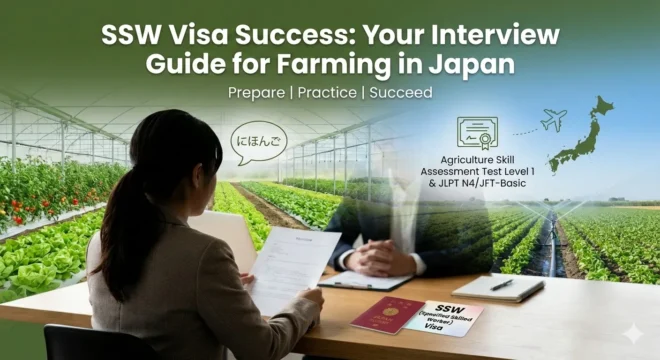
SSW Visa Interview Preparation for Crop Farming: A Complete Roadmap (Beginner to Advanced)
Securing a Specified Skilled Worker (SSW) visa for crop farming in Japan requires thorough preparation. This guide will take you from basic understanding to advanced mastery of the interview process.

Beginner Level: Building Your Foundation
If you’re just starting, focus on these essentials:
1. Understand the Basic Requirements
- Pass two mandatory tests: Agriculture Skill Assessment Test and Japanese Language Test (JFT-Basic or JLPT N4)
- Secure a job offer from a registered Japanese employer
- Valid passport and clean background check
2. Master Self-Introduction (Jikoshoukai)
Prepare a 30-second introduction in Japanese covering:
- Your name and country
- Your farming experience
- Why do you want to work in Japan’s agriculture sector
Example: “Hajimemashite. [Name] desu. [Country] kara kimashita. [Number]–nen no nougyou keiken ga arimasu. Nihon de nougyou no shigoto o shitai desu.”
3. Study Basic Japanese for Farming
Learn essential vocabulary:
- Crops: tomato (tomato), tamanegi (onion), kome (rice)
- Actions: ueru (to plant), mizu o yaru (to water), shuukaku suru (to harvest)
- Equipment: torakuta (tractor), supurinkura (sprinkler)
Intermediate Level: Developing Competence
Once you’ve mastered the basics, focus on practical knowledge:
1. Deepen Technical Farming Knowledge
Be ready to discuss:
- Specific crops you’ve cultivated (growth cycles, challenges)
- Equipment operation and safety procedures
- Basic pest control and irrigation methods
2. Prepare for Common Interview Questions
Practice answering these in both English and Japanese:
- “What experience do you have with [specific crop]?”
- “How would you handle an equipment malfunction?”
- “Can you work in cold/hot weather conditions?”
3. Understand Japanese Work Culture
- Punctuality is crucial (arrive early)
- Respect hierarchy (use polite language with supervisors)
- Teamwork is valued over individual achievement
Advanced Level: Mastering the Interview
For those aiming to excel:
1. Develop Scenario-Based Responses
Prepare for situational questions:
- “If you don’t understand instructions, what will you do?”
→ “Sumimasen, mou ichido onegaishimasu.” (I’m sorry, could you repeat that?) - “How will you handle conflicts with coworkers?”
→ Focus on respectful communication and supervisor mediation
Visit here:
2. Demonstrate Cultural Adaptation
Show you’ve researched:
- Life in rural Japan (limited entertainment, community-focused)
- Seasonal work variations in Japanese agriculture
- Japanese safety standards and protocols
3. Create a 5-Year Professional Plan
Articulate your goals:
- Skills you want to develop in Japan
- How does this experience fit your career trajectory
- Understanding that SSW(i) is temporary (maximum 5 years)
Practical Preparation Timeline
8 Weeks Before Interview:
- Complete required tests
- Gather all documents (passport, certificates, job contract)
- Begin daily Japanese practice (30 minutes minimum)
4 Weeks Before Interview:
- Practice mock interviews daily
- Record yourself answering questions
- Research your specific farm/region in Japan
1 Week Before the interview:
- Review all documents
- Practice with a partner if possible
- Prepare interview attire (business casual)
Day Before Interview:
- Get adequate rest
- Review key Japanese phrases
- Prepare documents in an organized folder
Key Success Factors
- Language Preparation: Even with JLPT N4, practice practical workplace Japanese
- Technical Knowledge: Be specific about your farming experience
- Cultural Awareness: Show respect for Japanese customs and work ethic
- Realistic Expectations: Understand rural living conditions and work demands
- Genuine Motivation: Express sincere interest in agricultural work, not just working in Japan
Common Pitfalls to Avoid
- ❌ Being unprepared for basic questions about your experience
- ❌ Underestimating the importance of Japanese language skills
- ❌ Not researching the specific farm/company
- ❌ Showing inflexibility about work/living conditions
- ❌ Focusing only on salary/benefits rather than the work itself
Final Checklist
✅ All required tests passed and certificates available
✅ Self-introduction memorized in Japanese
✅ 10+ common questions practiced
✅ Understanding of SSW visa conditions
✅ Knowledge of Japanese farming practices
✅ Appropriate interview attire ready
✅ All documents organized
Remember: The interview assesses both your farming skills and your ability to adapt to working and living in Japan. Successful candidates demonstrate technical competence combined with cultural sensitivity and a genuine commitment to agricultural work.
Your preparation journey reflects the dedication you’ll bring to Japanese farms. Start with the basics, build your knowledge systematically, and approach the interview with confidence in both your skills and your readiness for this new chapter.
Good luck! Ganbatte kudasai! (Do your best!)