Japanese Sentence Structure: The Key to Natural-Sounding Japanese
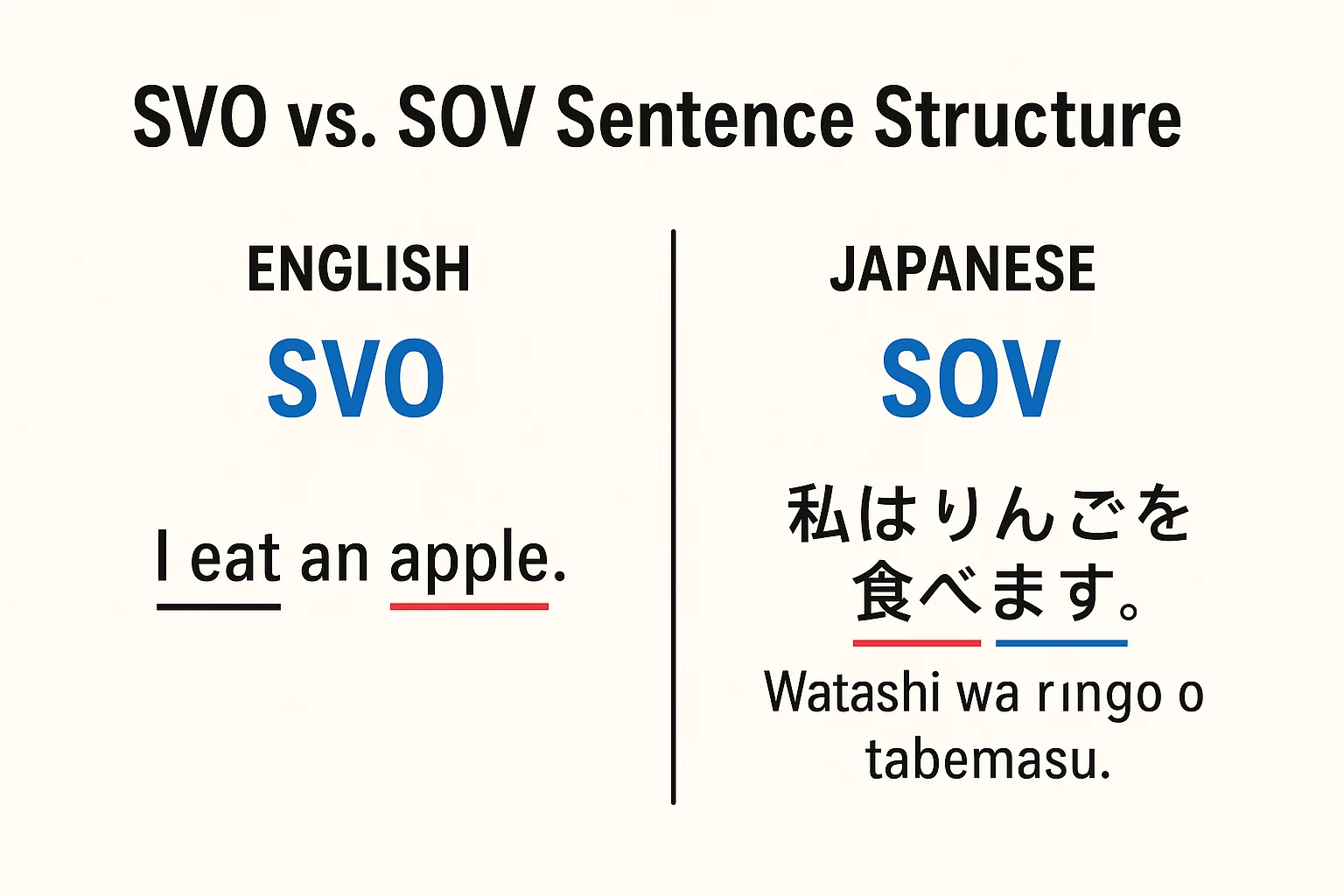
Learning Japanese sentence structure is one of the most important steps toward speaking and writing naturally in Japanese. Unlike English, which follows a Subject-Verb-Object (SVO) pattern, Japanese uses a Subject-Object-Verb (SOV) structure. Understanding this key difference helps learners build sentences correctly and sound more like native speakers.
1. Understanding the Basic Japanese Sentence Structure (SOV)
The basic Japanese word order follows this pattern:
👉 Subject + Object + Verb
Example:
-
私はりんごを食べます。
Watashi wa ringo o tabemasu.
→ “I eat an apple.”
Here:
-
私は (Watashi wa) = I (subject)
-
りんごを (ringo o) = apple (object)
-
食べます (tabemasu) = eat (verb)
In Japanese, the verb always comes at the end, no matter how long or complex the sentence becomes.
2. How Japanese Word Order Differs from English
In English, we say, “I eat an apple.”
But in Japanese, it becomes “I am apple eat.”
This reversal is due to the SOV sentence structure. Once you internalize this pattern, forming sentences becomes much easier.
Tip: Focus on placing the verb at the end—it’s the heart of every Japanese sentence.
3. Role of Particles in Japanese Grammar
Particles like は (wa), を (o), and に (ni) define the grammatical role of each word.
| Particle | Function | Example | Translation |
|---|---|---|---|
| は (wa) | Marks the topic | 私は学生です。 | I am a student. |
| を (o) | Marks the object | 水を飲みます。 | I drink water. |
| に (ni) | Indicates direction or time | 学校に行きます。 | I go to school. |
Without particles, Japanese sentences become unclear. They are small but powerful tools that define the basic grammar of Japanese.
4. Building Natural-Sounding Sentences
To sound natural, try using the topic-comment structure. In Japanese, sentences often start with what the speaker wants to talk about (the topic).
Example:
-
日本では桜がきれいです。
Nihon de wa sakura ga kirei desu.
→ “In Japan, cherry blossoms are beautiful.”
Here, 日本では (in Japan) sets the topic, making the sentence flow naturally.
Also, visit here:
5. Tips to Master Japanese Sentence Structure
-
🧠 Think in Japanese order: Subject → Object → Verb.
-
🗣️ Listen to native speakers: Pay attention to natural phrasing in anime, dramas, or podcasts.
-
✍️ Practice daily: Create 3–5 simple sentences each day.
-
📚 Study particles carefully: They’re the backbone of sentence meaning.
6. Common Mistakes to Avoid
❌ Placing the verb too early in the sentence.
❌ Forgetting to use particles.
❌ Translating directly from English to Japanese has its own rhythm and flow.
Always remember: “Verb last” is the golden rule.
Conclusion
Mastering Japanese sentence structure isn’t hard—it’s just different. By understanding the SOV word order and using particles correctly, you’ll quickly move from robotic translations to smooth, natural Japanese. Keep practicing, and soon your Japanese will sound native and confident!