🈶 Japanese Particles Explained: は vs が, に vs で (With Examples)
If you’ve started learning Japanese, you’ve probably realized one thing—particles (助詞, joshi) are everywhere.
They’re small words like は (wa), が (ga), に (ni), and で (de) that connect nouns, verbs, and adjectives—and completely change the meaning of a sentence depending on how they’re used.
In this guide, we’ll demystify these confusing little words using simple rules, natural examples, and cultural notes—so you’ll never mix them up again!
🎌 What Are Japanese Particles?
Particles are short grammatical markers placed after words to show their role in a sentence, like “to,” “in,” “on,” or “but” in English.
For example:
-
わたしはせんせいです。 (Watashi wa sensei desu.) → I am a teacher.
-
がっこうにいきます。 (Gakkou ni ikimasu.) → I go to school.
-
がっこうでべんきょうします。 (Gakkou de benkyou shimasu.) → I study at school.
Even though these particles are short, they define who does what, where, and how—making them the backbone of Japanese grammar.
Part 1: は (Wa) vs が (Ga)—The Most Confusing Pair
Let’s start with the most misunderstood duo: wa (は) and ga (が).
They both come after nouns and seem similar—but they express different emphasis.
Click here for the video course
⚖️ 1. は (Wa) — Topic Marker
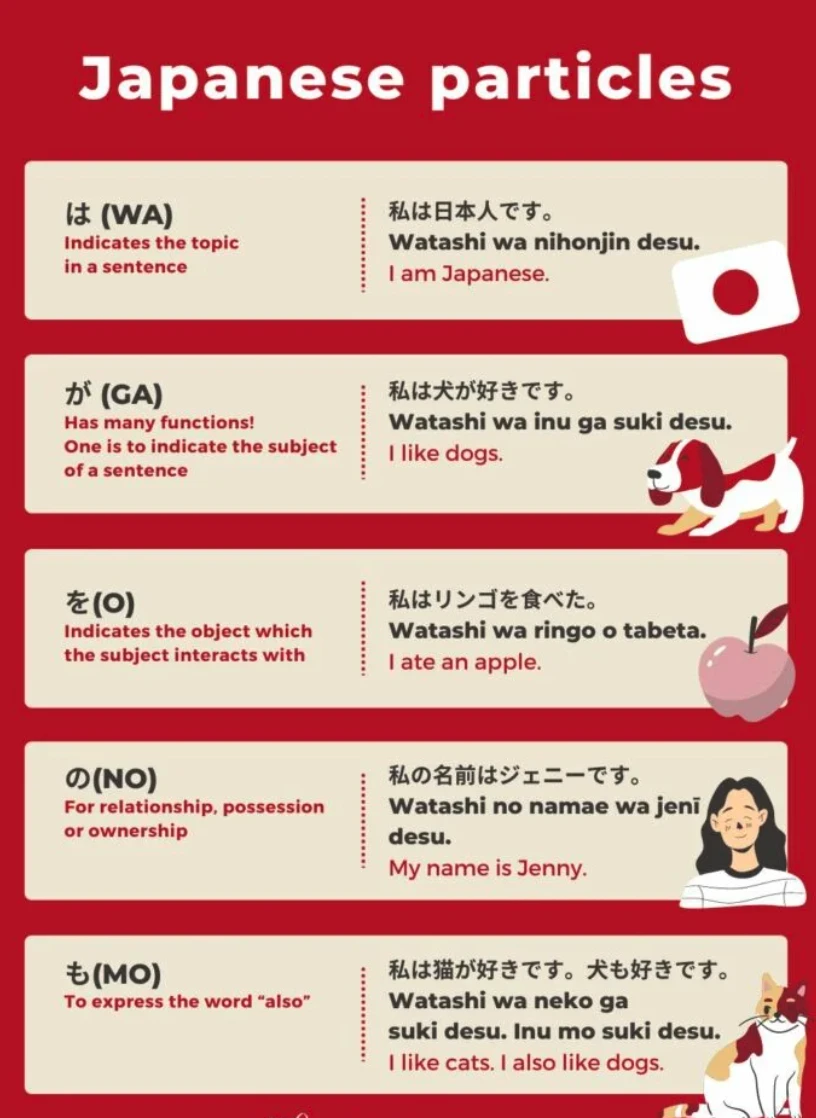
Function: Introduces the topic or what you’re talking about.
It sets the context, not necessarily the subject.
✅ Examples:
| Japanese | Romaji | English |
|---|---|---|
| わたしはせんせいです。 | Watashi wa sensei desu. | As for me, I am a teacher. |
| 日本はきれいです。 | Nihon wa kirei desu. | As for Japan, it is beautiful. |
💡 Think of “wa” as saying: “As for ___,” or “Speaking of ___.”
Use “wa” when:
-
You’re introducing a topic or contrast
-
The subject is already known
-
You’re giving background information
⚠️ Common Mistake:
❌ Watashi ga sensei desu (I am the teacher) ≠ “I’m a teacher.”
It actually means “I am the one who is the teacher.” (emphasizing identity)
🧭 2. が (Ga)—Subject Marker
Function: Identifies the specific subject that acts or is being described.
It’s often used to:
-
Introduce new information
-
Highlight what’s important
-
Answer “who” or “what” questions
✅ Examples:
| Japanese | Romaji | English |
|---|---|---|
| だれがきましたか? | Dare ga kimashita ka? | Who came? |
| たなかさんがきました。 | Tanaka-san ga kimashita. | Tanaka came. |
| 猫が好きです。 | Neko ga suki desu. | I like cats. (lit. Cats are likable to me.) |
💬 Tip: When introducing something new, use “ga.”
When continuing the same topic, use “wa.”
⚖️ Compare:
| Sentence | Meaning |
|---|---|
| わたしはねこがすきです。 | As for me, I like cats. |
| 猫が好きです。 | (It’s cats that I like.) — emphasizes cats. |
So:
-
wa = topic (what we’re talking about)
-
ga = focus (what’s important right now)
Part 2: に (Ni) vs で (De)—Location and Direction Explained
Another classic confusion: both ni (に) and de (で) can mean “at” or”in”—but they indicate different actions.
🗺️ 1. に (Ni)—Location/Direction Marker
Function: Points to a destination, target, or state of existence.
Visit here for N4 & N5 listening practice: Click
✅ Examples:
| Japanese | Romaji | English |
|---|---|---|
| がっこうにいきます。 | Gakkou ni ikimasu. | I go to school. |
| いすにすわります。 | Isu ni suwarimasu. | Sit on a chair. |
| にほんにすんでいます。 | Nihon ni sundeimasu. | I live in Japan. |
💡 Mnemonic: “Ni” = pinpoint a place or goal.
🏠 2. で (De)—Action Location Marker
Function: Marks the place where an action occurs.
✅ Examples:
| Japanese | Romaji | English |
|---|---|---|
| がっこうでべんきょうします。 | Gakkou de benkyou shimasu. | I study at school. |
| レストランで食べます。 | Resutoran de tabemasu. | Eat at a restaurant. |
| バスでいきます。 | Basu de ikimasu. | Go by bus. |
💬 Mnemonic: “De” = where you DO something.
⚖️ Compare:
| Sentence | Meaning |
|---|---|
| がっこうにいきます。 | Go to school. (destination) |
| がっこうでべんきょうします。 | Study at school. (action place) |
Simple rule:
-
に = where you go / exist
-
で = where you do/act
🌸 Summary Table: Wa vs Ga / Ni vs De
| Function | Particle | Core Meaning | Example |
|---|---|---|---|
| Topic marker | は (wa) | “As for…” | わたしはにほんじんです。 |
| Subject marker | が (ga) | Focus/emphasis | だれがきましたか? |
| Destination/existence | に (ni) | “to,” “in,” “on” | にほんにすんでいます。 |
| Action location/means | で (de) | “at,” “by,” “with” | バスでいきます。 |
💬 Bonus: When Wa and Ga Appear Together
Sometimes both appear in one sentence!
Example:
わたしはねこがすきです。
(Watashi wa neko ga suki desu.)
“As for me, I like cats.”
Here, “wa” introduces who we’re talking about, and “ga” marks what we like.
🎧 Pronunciation Practice
For clear listening examples, use:
🎙️ Say sentences aloud — rhythm and intonation make all the difference in sounding natural.
🌺 Conclusion: Mastering the Heart of Japanese Grammar
Particles might seem tiny, but they’re the DNA of Japanese grammar.
Once you understand wa, ga, ni, and de, you’ll unlock clearer sentences, deeper meanings, and more natural conversation.
💡 In short:
は = Topic (as for…)
が = Subject (focus/emphasis)
に = Destination or existence
で = Action location or means
Keep practicing with real-life phrases—read manga panels, watch anime, or listen to daily Japanese.
Soon, you’ll instinctively know which particle fits—just like a native speaker!